
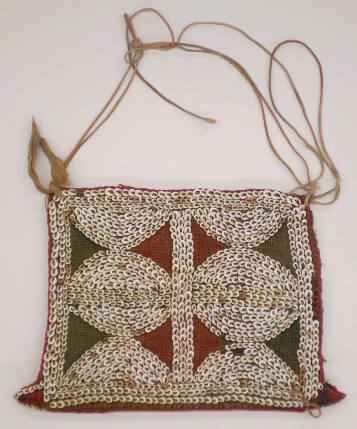

Currency Mat
ClassificationsCurrency and Exchange Objects
Datemid to late 20th Century
Collection SiteMorobe Province, Papua New Guinea
Made AtMorobe Province, Papua New Guinea
MediumShell, plant fiber, and pigment
Dimensionswithout strings: 9 1/4 × 11 1/4 × 1/2 in., 19.2 oz. (23.5 × 28.6 × 1.3 cm, 0.544 kg.)
Credit LineAnonymous Gift
Object number2017.10.56
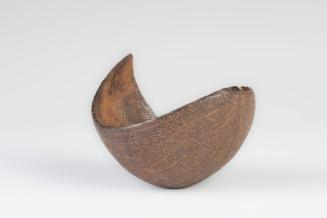
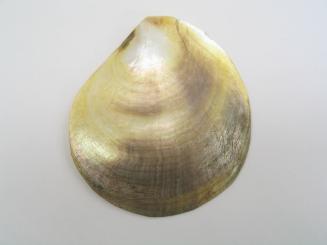
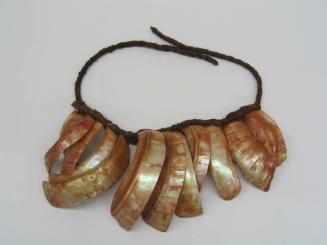
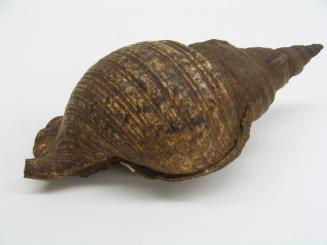
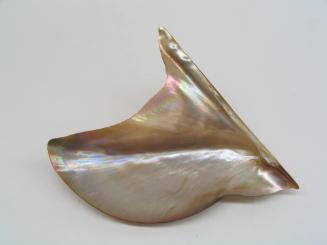
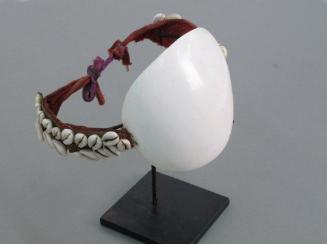
DescriptionIn many Melanesian communities, shells were utilized as a form of currency and simultaneously as supplies for high-priced commodities. As a form of currency, shells were used in trades along the coast and nearby islands. The further distance a shell traveled, the higher their value would increase. Therefore, the price and social value of a shell-made object increased depending on the inclusion of a well-traveled shell. A shell will signify important qualities about the wearer their wealth, initiation level within a clan membership, and ideas of ritual practice. As a bride price exchange, the use of particular shell may indicate the bride new family’s financial and social influence in the community.This style of bride prince is used in New Guinea’s Morobe Province. Nassa shells are sewn onto palm fiber and then given a backing of barkcloth. The shells, which come from a species of mud snail that is endemic throughout much of the Pacific Ocean, are a common feature of bride price where their small size allows them to easily be manipulated into attractive geometric shapes.
This piece of shell currency was collected from the Morobe Province of Papua New Guinea.
On View
Not on view
mid 20th Century
late 20th Century
mid 20th Century
mid 20th Century
late 19th to early 20th Century
mid-20th Century
mid to late 20th Century
mid 20th Century
mid 20th Century

mid 20th Century